
EuroSDR Workshop on Sustainable Business Models for NMCAs
Workshop organised by EuroSDR and hosted by NGI Belgium Brussels, Belgium
National Mapping and Cadastral Agencies (NMCAs) have an important role, providing geospatial data and services that are the backbone of social, economic and environmental services of the countries and territories they serve. All geospatial agencies are facing increasing challenges: limited resources, financial constraints, rapid technological advancements and legislative/national obligations, and competition from challengers from alternative providers of tools and services.
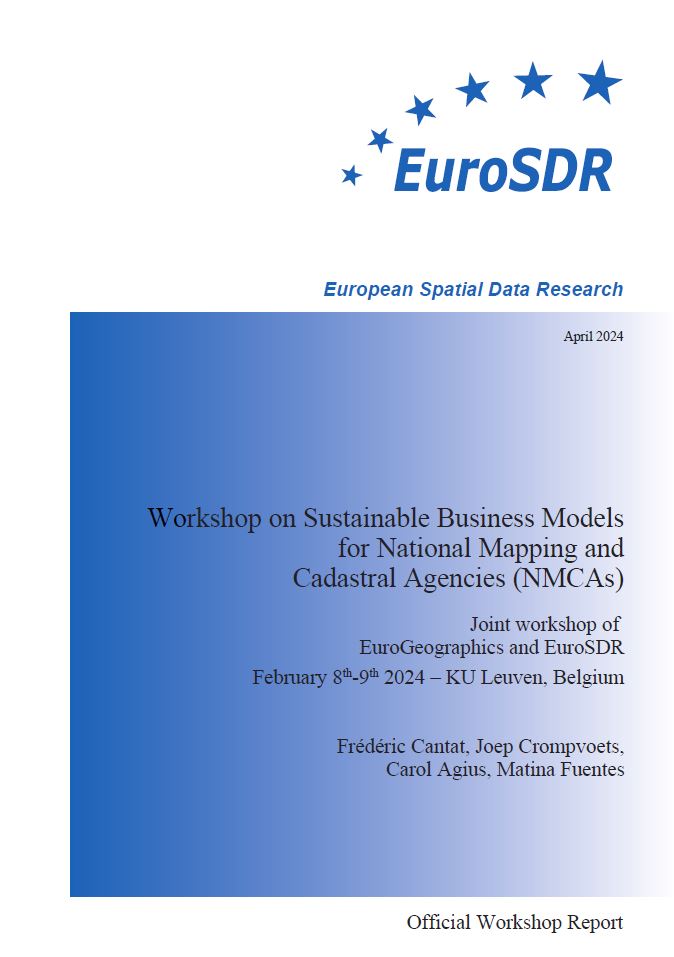
For EU NMCAs’s players, the European Commission implementing regulation 2023/138 laying down a list of specific high-value datasets and the arrangements for their publication and re-use published[1] in January 2023, has officially ratified the fact that NMCAs are enforced to provide geospatial data as machine readable open data since February 2025 (which was the ultimate deadline to comply with). This is at a cost to the National Government, which has to face since Early 2020s in many countries to delicate budgetary arbitrations. “I have learned that the Open Data directive HVD implement act is not so simple than the European Commission said. There is a real big shift between all NMCAs willing to share their data but they all need money to do so. It definitely has a cost!” was one the main takeaways from the workshop on Sustainable Open Data Business Models for NMCAs led jointly by EuroSDR and EuroGeographics in 2024. And there was a general agreement “on the necessity to take another look at the situation in two years (early 2026) with a repetition of this workshop” (cf. report[2] by Frédéric Cantat, Joep Crompvoets, Carol Agius and Matina Fuentes – EuroSDR’s Official publication – 2024).
That’s why EuroSDR invites NMCAs, researchers and policy makers to present, discuss and share their experiences during a dedicated lunch-to-lunch workshop on 9 and 10 February 2026 hosted by NGI-IGN Belgium in Brussels. This activity seeks to provide an inventory of which Business Models NMCAs have implemented, are implementing or will plan to implement to adapt themselves to their environment:
- How do they handle with the entry in force of the HVD regulation?
- Do they have to find extra-funding (e.g. fundings that are not State subsidy for public service charge nor reuse fees)?
- Do they have to alter activities, stopping some activities, to start new ones or to adapt the way they operate others?
- Do they have to build partnerships with new actors?
- How do they manage to integrate new key competences?
- What is the initial assessment from the EC perspective and what are the possible evolutions on the Data Union Strategy, especially with the very recent release in November of Digital Omnibus EU Regulation Proposal[3] in order to amend several “data” directives /regulations?
- Could the evolution of the international situation have an impact (on sovereignty or safety criteria for instance)? If yes, how?
- Etc.
Call for proposals/Presentations: If you would like to present at this workshop, please send your abstract to EuroSDR@mu.ie before 15 January 2026.
Venue of the workshop:
NGI-IGN Belgium, Ferraris room, Avenue de Cortenbergh 115, 1000 Bruxelles, Belgium
Accessibility: https://ngi.be/fr/accessibilite/ (in French) or https://ngi.be/bereikbaarheid/ (in Dutch)
Registration limited to 20 seats
Program overview:
DAY 1
12:00: Registration and lunch
14:00: Workshop opening
18:00: End of Day 1
20:00: Dinner (at your own expense)
DAY 2
09:00: Opening of Day 2
13:00: Close and Lunch
Related publications

Registration form

